elan1 RUN · CONTRACTS
Write against the contract, never the component.
elan1 Run Contracts are ten versioned fusion.*/v1 capability contracts that sit between your applications and the open-source AI stack, covering capabilities such as model serving and retrieval. Each contract has two licence-clean implementations, so applications are written against the contract and a component can be replaced without rewriting the integration.
Available now, in every elan1 Run subscription.
01What it does
A capability with one implementation is a dependency, not a contract.
Each contract has a written descriptor in five parts: surface, promises, state, meters and test vectors. The SDKs (Python, TypeScript, Go), the routing table, the conformance assertions and the API docs are generated from it. Promises belong to the contract, not the component.
| Contract | Example implementations |
|---|---|
| second implementation still open | |
| LiteLLM · Bifrost · Portkey | |
| vLLM · SGLang · LocalAI | |
| RAGFlow · Onyx | |
| pgvector · Qdrant | |
| Langfuse · Opik · MLflow | |
| ContextForge · agentgateway · ToolHive | |
| Temporal · Prefect · Dagster | |
| Mem0 · Cognee | |
| Presidio · NeMo Guardrails · elan1 Run's own engine |
Open-source projects named for reference. No endorsement by them is implied.
02Who it's for
Teams who keep rebuilding the same integration.
- Platform teams tired of rebuilding integrations each time a project is archived, relicensed or acquired.
- Systems integrators and GPU operators delivering the same stack to many clients.
03How it works
Your code names the contract. The spec names the component.
Five steps from your application to the implementation behind the contract.
- Your application calls fusion.<name>/v1, never a component's own API.
- Your stack spec names contracts, not products. Changing a component is a one-line diff in the spec.
- Every call passes the edge, where tenancy, budget and attribution are stamped once.
- The contract proxy routes to the bound implementation and labels the call with an X-Fusion-Contract header.
- A breaking change gets a new major version. Both are served for at least two quarters, with a quarter's notice.
04In the console
The contracts, as the console shows them.
The contract board, one contract's ranked bindings and the licence register behind every pinned component.
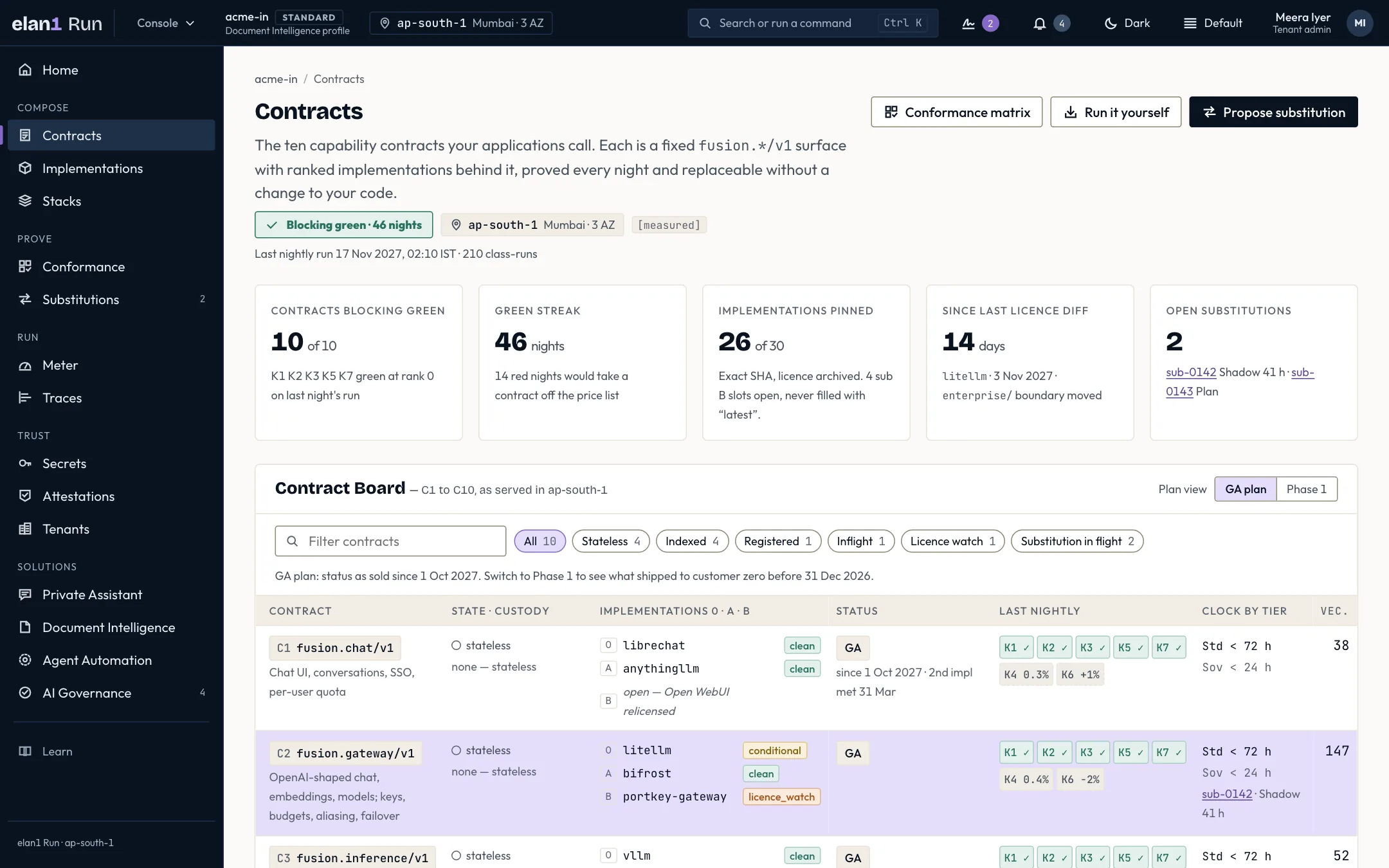
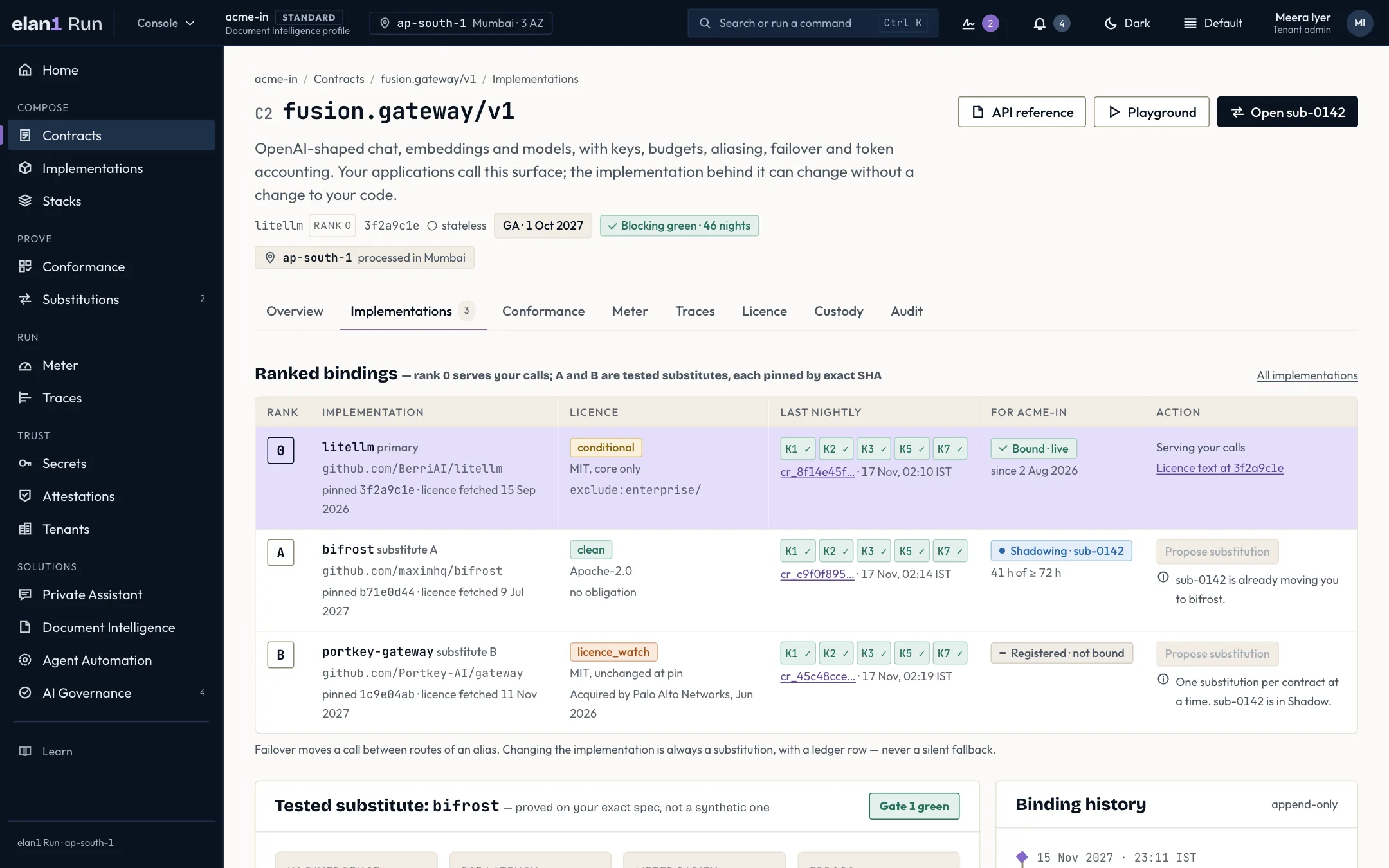
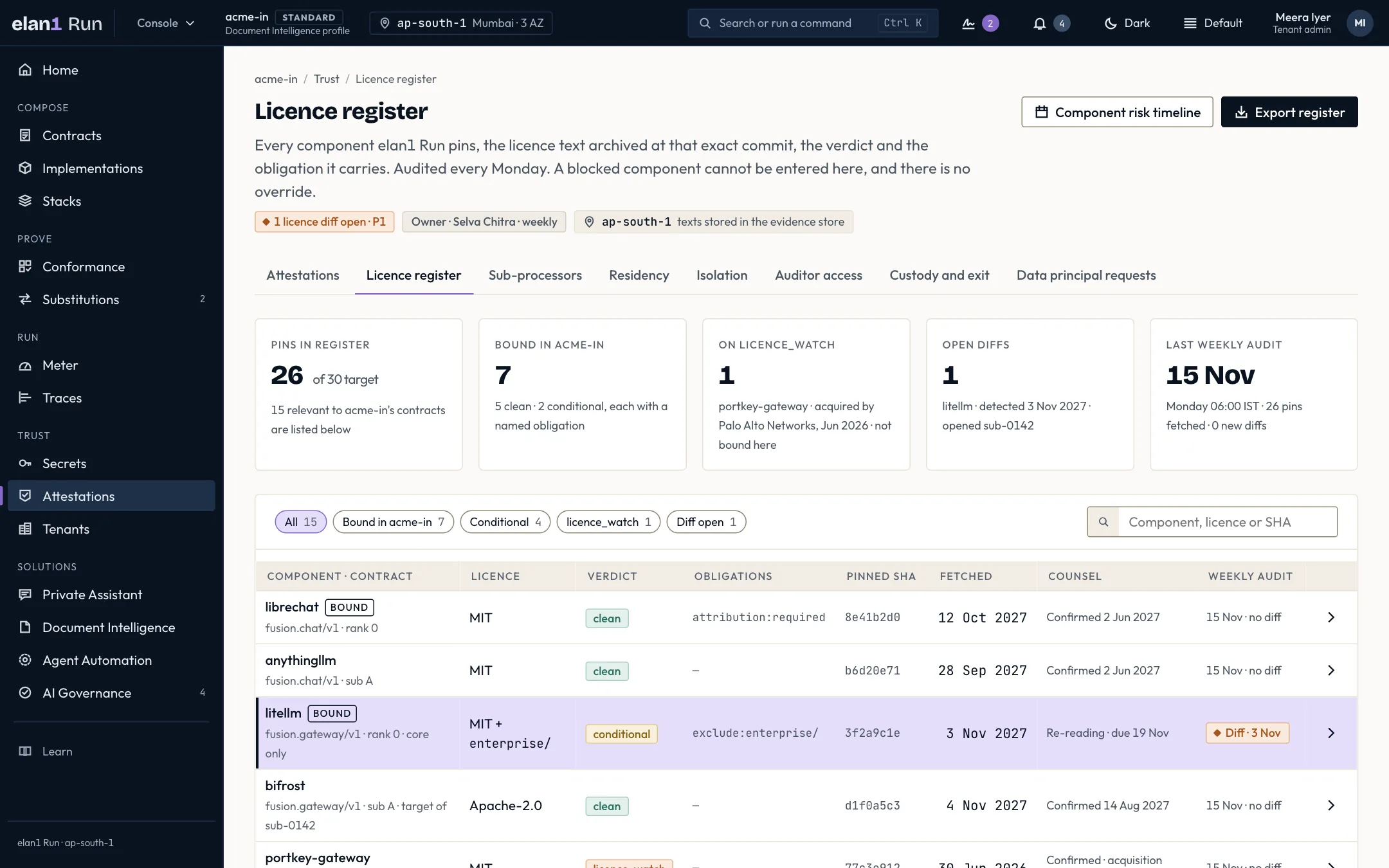
Illustrative specimen. Not customer data. Fictional sandbox data from the console design.
05What it connects to
Every layer calls the same contracts.
Work, Decide and Govern all run on these contracts, and none gets a private door. Five carry Govern’s work: gateway, trace, tools, run and guard. Writes go through elan1 Govern. elan1 Run governs the call; elan1 Govern governs the write.
Writes go through elan1 Govern.
06What it costs
Included in every subscription.
The unit
One node-year
Per node and per GPU. Runtime units are counted and shown, never priced.
Contracts are included in every elan1 Run subscription. No SKU is named after a component.
| What | Price · excl. GST | Includes |
|---|---|---|
| Starter | ₹1,80,000 per year | 2 CPU nodes included |
| Standard | ₹6,00,000 per year | Plus nodes and GPUs under management |
| Sovereign | ₹24,00,000 per year | Plus nodes and GPUs under management |
| CPU node under management | ₹1,80,000 per node per year | |
| GPU under management | ₹1,80,000 per GPU per year | |
| Paid 90-day pilot | ₹4,50,000 | |
| A call refused at the edge | 40% of one governed action (₹0.64 at the L1 rate) | Returns a 409 before the first token, so no token is sent |
All prices are exclusive of GST. Prices are current list prices; GST is added at the applicable rate on the invoice.
- Tokens and the six runtime units are counted, never priced.
- First purchase: a paid 90-day pilot, or a Starter subscription on elan1 Run Cloud.
All prices are exclusive of GST. GST is added at the applicable rate on the invoice.
07Status
Ten contracts, available now.
fusion.memory/v1 is in limited availability; the other nine are generally available.
- Govern's fivegateway, trace, tools, run and guard: the contracts Govern's work runs on.Status: Available
- The other fivechat, inference, retrieval, vectors and memory.Status: Available
08What it does not do
What Contracts do not do.
- It does not resell inference or own GPUs.
- It does not decide whether a business write may happen. That is elan1 Govern’s job.
- It does not extend a contract's promises to calls made straight to a component.
09FAQ
Six direct answers.
A fusion.*/v1 contract is a versioned interface between your applications and one capability of the open-source AI stack, such as chat, inference, retrieval or vectors. Your code calls the contract, never the vendor, so the component behind it can change without rewriting the integration.
So that no contract depends on a single component. Each contract has two licence-clean implementations, both checked by the K1–K7 conformance suite, which keeps a governed substitution open whenever one of them has to be replaced.
Ten capabilities: chat, gateway, inference, retrieval, vectors, trace, tools, run, memory and guard. Examples of components behind them include LiteLLM, vLLM, pgvector, Langfuse and Temporal; fusion.memory/v1 is in limited availability.
Yes, through direct access, but the contract's promises do not cover those calls. If more than 15% of traffic goes direct, the contract needs a new version.
Nine are. fusion.memory/v1 is in limited availability. Every contract has two licence-clean implementations, so none is a dependency.
Only through the licence register and the conformance suite. A component with a blocked licence cannot be registered.
10Next steps
Where to go from here.
Next steps
One write path, four layers
Work and Decide propose. Govern and Run assure. Only Govern allows.
// elan1 RUN · CONTRACTS
Write against the contract, never the component.
Start with a paid 90-day pilot: your stack behind the contracts, conformance running nightly, every call counted.